
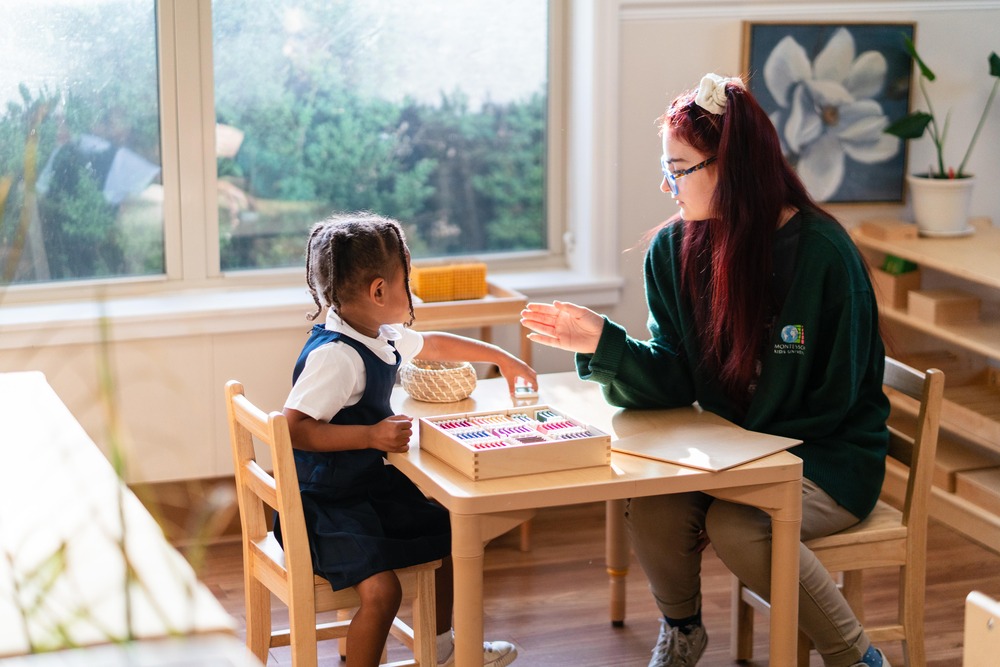
You walk into one preschool and see children working together on a teacher-led activity. At another, children are choosing hands-on materials, working independently, and moving through the classroom with purpose. Both classrooms are filled with learning, but the experience looks very different.
If you’re comparing Montessori vs. traditional preschool, you may be wondering what actually separates the two. Is one more academic? Does Montessori give children too much freedom? How do teachers guide learning when children work at their own pace? And how will Montessori support your child academically?
The main difference is how learning is structured. Traditional preschool often includes more teacher-directed group learning. Montessori combines teacher guidance with individualized, hands-on experiences that allow children to develop skills at their own pace.
Both approaches can provide meaningful early learning experiences. However, understanding their differences can help you decide which environment best matches your child’s personality, learning style, and needs.
Montessori vs. Traditional Preschool: How Does Learning Differ?
One of the biggest differences is how learning is structured.
In many traditional preschool classrooms, teachers guide the group through activities on a shared schedule. Children may participate in circle time, complete the same project, or move together from one activity to another.
Montessori takes a more individualized approach. Teachers prepare the environment with developmentally appropriate materials and introduce activities based on each child’s abilities and readiness.
This gives children opportunities to:
- Make age-appropriate choices
- Explore concepts through hands-on experiences
- Work at their own pace
- Repeat activities until they feel confident
- Strengthen concentration
- Take an active role in their learning
The goal isn’t to remove structure. Instead, Montessori provides structure that allows room for independence.
The classroom is carefully prepared, expectations are clear, and teachers provide intentional guidance. The difference is that the structure leaves room for children to develop independence within appropriate boundaries.
What Is the Teacher’s Role in a Montessori Classroom?
Picture a child trying to complete a new activity. It would be easy for an adult to step in, show them the answer, and move on.
A Montessori teacher takes a different approach.
Often called guides, Montessori educators carefully observe children and introduce lessons when they are developmentally ready. Then, they give children time to practice, make discoveries, and work through challenges.
Instead of directing every moment, the teacher helps create an environment where children can become active participants in their own education.
That small shift can have a big impact. When children discover they can solve a problem themselves, they begin to build confidence that extends far beyond the classroom.
Over time, those small successes can also help build persistence, concentration, and a willingness to try something new.
Why Does Montessori Encourage Independence?
If you have ever watched a preschooler insist, “I can do it myself,” you’ve already seen the natural desire for independence in action.
Montessori embraces it.
Children are encouraged to participate in everyday tasks such as:
- Putting away materials
- Pouring their own water
- Caring for plants
- Cleaning up their workspace
- Practicing dressing skills
- Helping classmates
These Practical Life experiences may look simple, but they help children develop responsibility, coordination, concentration, and self-confidence.
In a traditional preschool, children may certainly practice many of these skills too. The difference is that independence is a central part of the Montessori philosophy and is intentionally woven throughout the learning environment.
What Does Montessori Look Like for Infants and Toddlers?
Montessori principles can begin long before preschool.
For infants and toddlers, Montessori is not about expecting children to be independent before they are ready. It is about creating a safe, thoughtfully prepared environment that supports natural development.
Teachers provide age-appropriate opportunities for movement, sensory exploration, language development, coordination, and emerging independence.
As toddlers grow, simple experiences can become meaningful learning opportunities. Reaching for an object, carrying something independently, putting an item away, or practicing self-care all help build important developmental skills.
The activities change as children grow, but the philosophy remains consistent: respect each child’s development while creating opportunities to explore and build new abilities.
At Montessori Kids Universe Louisville, programs begin at 8 weeks and continue through kindergarten, allowing families to choose a Montessori-based early learning environment through several important developmental stages.
Why Is Hands-On Learning Important in Montessori?
Young children learn by touching, moving, experimenting, and exploring.
Montessori classrooms are designed around that idea. Children work with carefully selected materials that allow them to physically explore concepts in math, language, sensory development, and practical life.
For example, rather than simply hearing a teacher explain a concept, a child may manipulate objects, arrange materials, compare sizes, count physical items, or repeat an activity until the concept makes sense.
This hands-on approach turns learning into something children experience rather than simply receive.
How Does Montessori Prepare Children Academically?
Yes. Montessori builds strong academic foundations through hands-on learning, individualized instruction, and opportunities to progress as children are ready.
Montessori classrooms introduce concepts in language, literacy, mathematics, science, and other academic areas through developmentally appropriate experiences. Children often begin with concrete, hands-on materials before progressing toward more abstract concepts as their understanding grows.
But academic preparation goes beyond learning letters, numbers, and early concepts.
Children also develop skills that support learning throughout school, including:
- Concentration and focus
- Problem-solving
- Following directions
- Communication
- Working independently
- Persistence through challenges
- Confidence when approaching something new
At Montessori Kids Universe Louisville, children can continue through kindergarten, allowing these skills and academic foundations to develop within a consistent Montessori learning environment.
The goal is not simply to prepare children for the next grade. It is to help them become confident, capable learners with the academic and developmental foundation to succeed as they continue their education.
Is Montessori Right for Every Child?
There isn’t one preschool philosophy that fits every child or every family.
The better question is: What type of environment will help your child thrive?
As you compare schools, think beyond the curriculum printed on a brochure. Consider how your child naturally approaches the world.
Do they love exploring and asking questions? Do they enjoy doing things independently? Are they happiest when they can work with their hands? Do you want an environment that gives them room to develop at their own pace?
Would they benefit from opportunities to repeat a skill until they feel confident? Do you value an environment that balances guidance with age-appropriate independence?
Most importantly, visit the schools you’re considering. Watch how teachers interact with children. Notice how the classrooms feel. Ask questions. Picture your child spending their days there.
What Should Louisville Parents Look for When Choosing a Preschool?
A curriculum can tell you a great deal about a school. A visit can tell you even more.
When touring a preschool in Louisville, pay attention to what you see and how the environment feels.
Are teachers engaged with the children? Do classrooms feel calm, purposeful, and welcoming? Are children actively participating in their learning? How does the school communicate with families? How are safety and security handled? What opportunities do children have to spend time outdoors?
Most importantly, try to picture your child there.
A premier early learning experience should offer more than an impressive curriculum. Parents should feel confident that their child will be known, supported, appropriately challenged, and cared for throughout the day.
Experience Montessori Kids Universe Louisville
Choosing between Montessori vs. traditional preschool ultimately comes down to finding an environment where your child feels safe, supported, curious, and excited to learn.
At Montessori Kids Universe Louisville, our approach brings together Montessori education, Reggio Emilia-inspired learning, and nature-based exploration to nurture children academically, socially, and emotionally.
Families can expect:
- Individualized learning that respects each child’s pace
- Hands-on experiences that encourage discovery and problem-solving
- Practical Life activities that build independence and confidence
- Creative exploration inspired by Reggio Emilia
- Nature-based learning that encourages curiosity about the world
- Intentional teacher guidance based on observation and development
- A safe, nurturing environment where children can learn and grow
Located on Old Henry Trail in East Louisville, Montessori Kids Universe Louisville is convenient for families in surrounding communities, including Middletown and Lake Forest.
If you’re looking for a Montessori preschool in Louisville, seeing the learning environment firsthand can help you decide if it’s the right fit for your family.
Reading about Montessori can help you understand the philosophy. Seeing it in action can help you picture what it could mean for your child.
Schedule a tour of Montessori Kids Universe Louisville to meet our teachers, explore our classrooms, and see how an individualized Montessori education can help your child build the confidence, independence, and love of learning that lasts well beyond preschool.
Montessori vs. Traditional Preschool: Frequently Asked Questions
Is Montessori better than traditional preschool?
Neither approach is automatically better for every child. Montessori may appeal to families who value individualized learning, hands-on experiences, independence, and opportunities for children to progress at an appropriate pace.
Is Montessori too unstructured for young children?
No. Authentic Montessori environments provide clear structure, expectations, routines, and carefully prepared learning spaces. Children have age-appropriate choices within those boundaries. This balance allows them to develop independence without removing teacher guidance.
What age should a child start Montessori?
Children can benefit from Montessori principles beginning in infancy. The environment and activities change with each developmental stage. Montessori Kids Universe Louisville serves children from 8 weeks through kindergarten, with programs designed for different ages and developmental needs.