
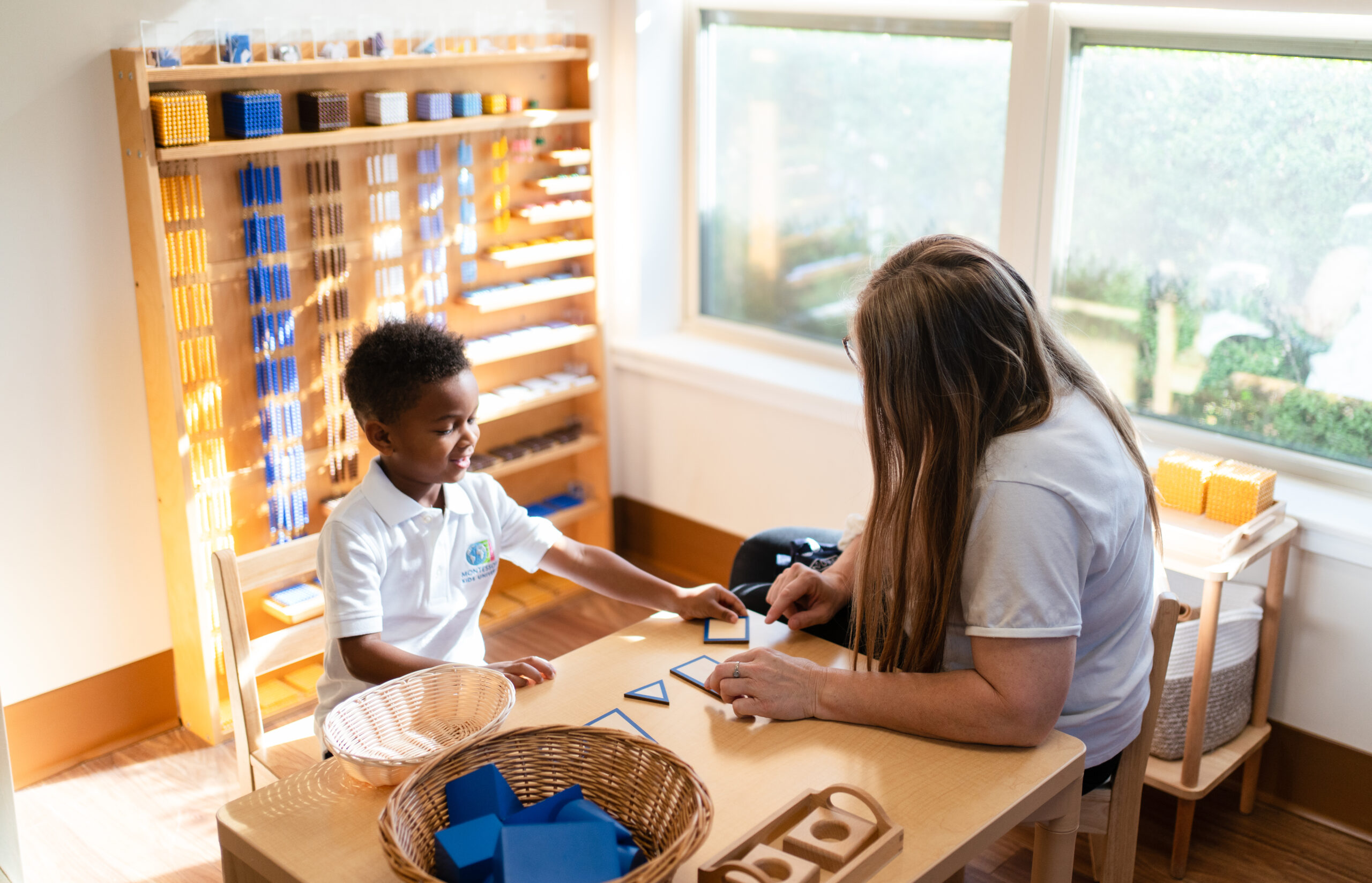
Your preschooler is building a tower, carefully stacking one block on top of another.
Then, just as they’re about to add the final piece, the whole thing comes crashing down.
What happens next?
Maybe they get frustrated and ask for help. Maybe they start over or try building it differently.
That’s problem-solving in action.
Children encounter small challenges every day, and learning how to work through them is an important part of their development.
Problem-solving activities for preschoolers help children practice critical thinking, independence, creativity, and persistence. At Montessori Kids Universe Louisville, hands-on learning gives children opportunities to explore challenges and discover solutions.
Why Are Problem-Solving Skills Important for Preschoolers?
Problem-solving involves more than finding the right answer. It teaches children how to approach challenges, make decisions, and adjust when something doesn’t work.
These experiences help preschoolers develop:
- Critical thinking: Considering different solutions
- Independence: Taking an active role in tasks and recognizing when help is needed
- Creativity: Exploring new approaches
- Concentration: Staying focused on a challenge
- Persistence: Trying again after a setback
- Confidence: Recognizing what they can accomplish
Many of these skills develop naturally through play, everyday responsibilities, and hands-on activities.
Asking for help is also a valuable problem-solving strategy. Children can practice independence while learning to communicate when they need support.
6 Problem-Solving Activities for Preschoolers
You don’t need complicated materials to help children practice problem-solving. Simple activities can encourage them to think, experiment, and learn from their experiences.
Choose materials suited to your child’s abilities, and supervise activities involving water, art supplies, or loose objects. Avoid small items that could pose a choking risk.
1. Puzzles and Matching Games
Puzzles encourage children to recognize shapes, compare possibilities, and figure out how pieces fit together.
Matching games offer similar benefits by challenging children to identify similarities, differences, and patterns.
Try it at home: Offer a puzzle with large pieces and a manageable difficulty level. If your child gets stuck, encourage them to examine the picture, shape, or edges before trying again.
Ask: “What do you notice about this piece?”
For an easier matching activity, start with two or three pairs of picture cards. Add more pairs as your child becomes comfortable.
Skills practiced: Logical thinking, concentration, and persistence.
2. Building With Blocks
Building activities encourage children to experiment with balance, structure, and design.
If a tower falls, they can try a wider base or rearrange the blocks. Each attempt gives them information they can use to improve their next design.
Try it at home: Invite your child to build a bridge between two blocks. Then, let them test whether it can support a toy car.
Ask: “What could you change to help your bridge hold the car?” Or if the bridge holds, “Why do you think the bridge was able to hold the car?”
If building a bridge feels too challenging, start with a short tower. Encourage your child to explore which blocks make a steady base.
Skills practiced: Planning, creativity, spatial awareness, and trial-and-error learning.
3. Sorting and Sequencing Activities
Give your child a collection of age-appropriate objects and encourage them to organize the items by color, size, or shape.
Then ask if they can find another way to sort them.
Sequencing activities, such as arranging pictures in the correct order, also encourage children to recognize patterns and relationships.
Try it at home: Gather several clean socks and invite your child to find matching pairs. Then, suggest sorting them another way, such as by size or color.
Ask: “Could these belong together for another reason?”
For sequencing practice, draw three simple pictures showing a familiar routine, such as washing hands. Let your child arrange them and explain what happens first, next, and last.
Skills practiced: Classification, reasoning, and decision-making.
4. Montessori Practical Life Activities
Everyday tasks can become meaningful learning experiences.
Pouring water, folding towels, setting the table, and organizing materials require children to plan their movements, make adjustments, and complete a task.
In Montessori education, these are known as Practical Life activities. They encourage independence while helping children develop coordination and concentration.
Try it at home: Place a small pitcher, a cup, and a cloth on a tray. Demonstrate pouring a little water, then invite your child to try.
If water spills, give them time to notice it and use the cloth. A spill becomes an opportunity to respond and try again.
Ask: “What could help you keep the water in the cup?”
Start with a lightweight pitcher and a small amount of water. Adjust the task so your child can participate comfortably.
Skills practiced: Independence, coordination, planning, and self-correction.
5. Open-Ended Art Activities
Instead of asking children to recreate a specific picture, provide art materials and let them decide what to make.
They can experiment with colors, combine materials, and change their approach as they work.
Open-ended activities encourage children to make decisions and explore different possibilities.
Try it at home: Offer paper, crayons, and several large pieces of colored paper. Invite your child to create something using the available materials.
If something tears or will not stay in place, pause before fixing it. Help your child consider another approach.
Ask: “What else could you try?”
There does not need to be one finished design or correct result. The decisions children make along the way are part of the learning.
Skills practiced: Creativity, flexibility, and independent thinking.
6. Outdoor Exploration
Nature offers plenty of opportunities for children to investigate questions.
Why do some objects float? What happens when water is added to soil? How can sticks and rocks be arranged to create a structure?
Gardening, nature walks, and simple outdoor experiments encourage children to observe, make predictions, and test ideas.
Try it at home: During a supervised outdoor activity, collect a few large, safe natural objects. Invite your child to predict which will float in a shallow container of water.
Ask: “What do you think will happen? What did you notice when we tested it?”
Encourage your child to compare their prediction with the result. Changing an idea after observing something new is part of problem-solving.
Skills practiced: Observation, curiosity, experimentation, and problem-solving.
How Montessori Encourages Problem-Solving Skills
Montessori education emphasizes purposeful, hands-on learning.
Rather than simply telling children how to complete every task, Montessori educators guide them while encouraging them to explore materials and discover solutions.
Many Montessori materials help children recognize and correct mistakes independently.
This principle is called “control of error.” The Association Montessori Internationale explains how it helps children notice and manage mistakes.
Feedback can also come from everyday tasks. When a child pours too much water into a cup, the overflow provides a visible result. With support, they can clean up and adjust how much they pour next time.
This encourages children to:
- Think through challenges
- Make decisions independently
- Learn from mistakes
- Practice concentration
- Develop persistence
The goal isn’t to eliminate adult guidance. It’s to give children appropriate opportunities to solve problems while receiving the support they need.
Adults can demonstrate a task, observe the child’s response, and offer help when needed. Independence develops through supported practice.
How MKU Louisville Supports Independent Thinking
At Montessori Kids Universe Louisville, we combine Montessori education, Reggio Emilia-inspired learning, and nature-based exploration.
Our Pre-Primary Program encourages curiosity, independence, and hands-on discovery. As children progress into the Primary Program, they continue developing concentration, early literacy, number sense, and social skills through individual and small-group learning experiences.
These programs encourage children to explore ideas, make choices, and approach challenges at their own developmental pace.
Through purposeful activities, creative expression, and exploration, children develop skills that support learning both inside and outside the classroom.
Our school environment supports everyday opportunities to practice independence. Children participate in routines such as setting the table and clearing their plates. These responsibilities give them meaningful ways to contribute while practicing familiar steps.
How Parents Can Encourage Problem-Solving at Home
You can help your preschooler develop problem-solving skills through everyday interactions.
Here are a few simple strategies:
- Ask open-ended questions. Try, “What else could you do?”
- Give them time. Allow your child to consider solutions before stepping in.
- Encourage different approaches. Show them that problems can have multiple solutions.
- Praise effort. Describe what you noticed: “You tried a wider base, and your tower stayed up.”
- Offer appropriate challenges. Choose activities that require some effort without becoming overwhelming.
- Manage frustration. Help children manage their frustration by acknowledging their feelings and offering a hint, a demonstration, or a break when needed.
Remember, children don’t need to solve every problem independently. Encouragement and age-appropriate guidance are important parts of learning.
Explore Hands-On Montessori Learning in Louisville
Problem-solving is just one of the many skills children develop through meaningful preschool experiences.
At Montessori Kids Universe Louisville, our programs encourage:
- Independent thinking and problem-solving
- Concentration and persistence
- Creativity and curiosity
- Early literacy and number sense
- Confidence and independence
- Communication and social development
Our East Louisville school serves children ages 8 weeks to 6 years at 14015 Old Henry Trail, Louisville, KY 40245. We are conveniently located near Middletown, Lake Forest, and I-265.
Want to see Montessori learning in action?
Schedule a tour to explore our classrooms and meet our educators. Ask how teachers introduce new activities, manage frustration, and help children work through challenges.
Frequently Asked Questions About Problem-Solving Activities for Preschoolers
What are good problem-solving activities for 3- to 5-year-olds?
Puzzles, building blocks, matching games, sorting activities, simple experiments, and Montessori Practical Life activities all encourage problem-solving. These activities give children opportunities to make decisions and try different solutions. Adjust materials and difficulty to your child’s abilities, not just age.
How can I help my preschooler develop problem-solving skills?
Offer age-appropriate challenges, ask open-ended questions, and give your child time to explore solutions. Encourage effort and provide guidance when needed rather than immediately completing tasks for them. If frustration builds, offer a small hint or work through one step together.
How does Montessori teach problem-solving?
Montessori education uses hands-on materials and purposeful activities that encourage children to explore, make decisions, recognize mistakes, and try different approaches. Educators provide guidance while supporting independence.
Why is problem-solving important for kindergarten readiness?
Problem-solving helps children develop critical thinking, independence, concentration, and persistence. These skills help them approach new activities, work with classmates, and navigate everyday classroom challenges.